
Design. Execute. Control.
The three disciplines of renewals excellence.
Helping organizations turn renewals into a predictable, scalable growth engine - without adding unnecessary complexity or headcount.

Design, execute, and control are not abstract ideas - they are distinct disciplines that must work together to scale renewals predictably. RenewalsHub brings them together into a single, integrated operating system.
How RenewalsHub structures renewals for scale and predictability.
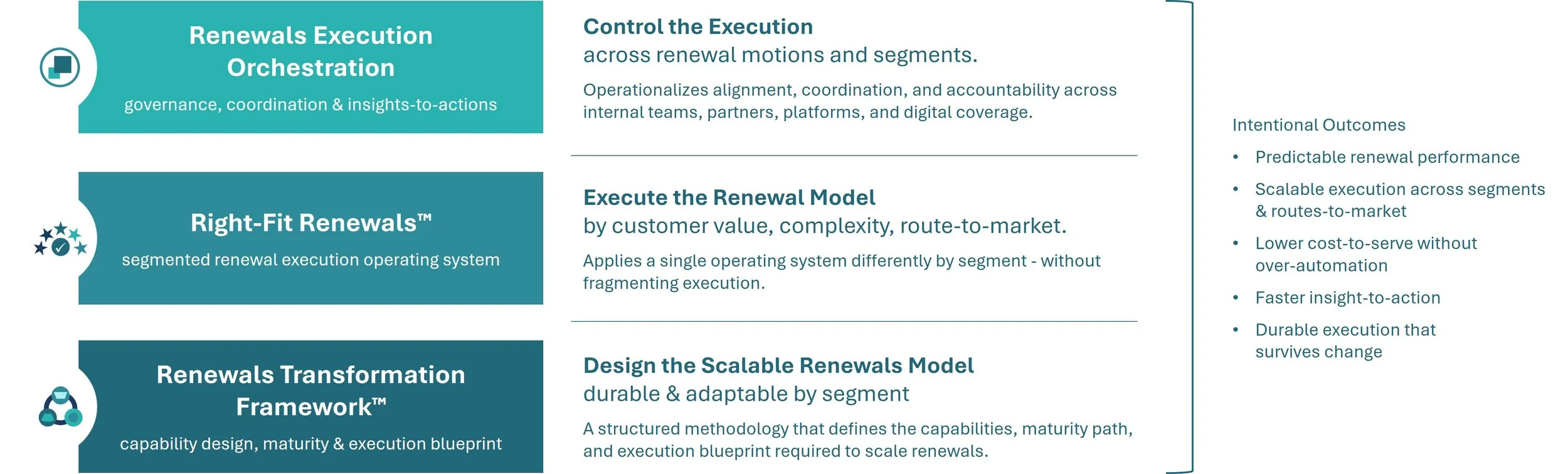
Together, these three disciplines form the RenewalsHub operating system for scalable, predictable renewals.
For Customer Success, Revenue Operations, and Renewal Leaders in SaaS, subscription, and recurring-revenue businesses, RenewalsHub helps B2B and B2C companies turn renewals from an afterthought into a predictable, scalable revenue engine - grounded in data, operational rigor, and disciplined execution.
Why Renewals Break at Scale
Execution rarely fails because teams lack effort - it fails because structure, design, and orchestration are treated as the same problem. It breaks because design, execution, and control are treated as the same problem.
Most renewal organizations rely on one-size-fits-all motions, manual workarounds, and automation layered onto fragile models. The result is predictable: inconsistency across segments, rising cost-to-serve, reactive escalations, and limited visibility into performance and risk.
Why Most Renewal Transformations Fall Short
Many initiatives focus on activity - adding tools, coverage, or automation - without first establishing a designed model, intentional execution by segment, and control mechanisms that maintain alignment as complexity increases.
Teams add tools, adjust coverage, or automate steps - without first designing a scalable model, aligning execution by segment, or establishing governance to keep execution aligned as complexity increases.
Without clear separation between how the model is designed, how it is executed, and how execution is controlled, even well-intended initiatives stall or regress over time.
The RenewalsHub Point of View
High-performing renewal organizations don’t optimize individual motions - they build a system.
RenewalsHub defines three disciplines that together form a scalable renewals system:
Design the scalable renewals operating model
Renewals Transformation Framework™
Execute renewals the right way by segment
Right-Fit Renewals™
Control execution to maintain alignment
Renewals Execution Orchestration™
Each discipline stands on its own - and reinforces the others.
Design the target operating standard for the renewals environment
The Renewals Transformation Framework™ establishes the capabilities, maturity path, and execution blueprint required to scale renewals.
It defines how renewals should work before decisions are made about segmentation, automation, or coverage.
Without a clearly designed model, execution becomes inconsistent and control becomes reactive.
How the Three Disciplines Work Together
Design, execution, and control are distinct yet interconnected. Renewals scale only when all three operate as a single system:

Execution operationalizes the model by segment
Right-Fit Renewals™ applies the designed model differently by customer value, complexity, and route-to-market - without fragmenting execution.
It ensures each segment receives the right level of engagement, automation, and coverage while operating within a single, coherent system.
Without intentional execution by segment, even well-designed models fail to scale efficiently.

Control keeps execution aligned as complexity increases
Renewals Execution Orchestration ensures segmented execution remains aligned as volume, routes-to-market, and change increase. It provides the governance, coordination, and insight-to-action mechanisms required to detect risk early, resolve friction, and maintain accountability across teams and partners.
Without control, execution drifts and predictability erodes over time.

Why all Three are Required
Most renewal organizations have pieces of each discipline - but not all three working together. Design without execution remains theoretical. Execution without control becomes chaotic. Control without design enforces the wrong behaviors.
When design, execution, and control operate as a system, renewals become predictable, scalable, and durable - even as complexity grows.
Where Organizations Typically Start
Organizations can engage with RenewalsHub at any point - design, execution, or control - based on their most pressing needs. The disciplines are modular, but the system holds.
Whether the priority is defining a scalable model, operationalizing segmented execution, or stabilizing execution across teams and partners, RenewalsHub provides a structured path forward without forcing a rigid sequence.
Where Renewal Transformation Typically Begin
Few organizations start renewal transformation from a clean slate. Most begin with a specific pressure point - not a mandate to redesign everything at once.
Over time, RenewalsHub has observed a small number of consistent entry patterns across high-growth and enterprise renewal organizations.
Pattern 1: Execution is breaking under scale
Renewal volumes are growing, but execution is inconsistent. Teams are overwhelmed by manual work, escalations are increasing, and outcomes vary widely by segment or route-to-market.
In these cases, organizations often begin by stabilizing execution - introducing segmentation, right-sizing coverage, and aligning execution within a single operating system.
Pattern 2: The model exists, but it doesn’t translate into execution
Leadership has a clear vision for how renewals should work, but the model isn’t consistently applied in the field. Different teams interpret priorities differently, and execution drifts as complexity increases.
Here, organizations typically focus on tightening the connection between design and execution - ensuring the model is operationalized intentionally by segment rather than left to local interpretation.
Pattern 3: Performance is opaque and reactive
Renewal risk is discovered late, forecasting lacks confidence, and intervention is often reactive. While activity levels are high, there is limited insight into what is working, where execution is breaking down, or why.
Organizations in this pattern often start by strengthening governance, insight-to-action loops, and cross-team coordination to regain predictability and control.
No single “right” starting point
These patterns are not stages - and they are not mutually exclusive. Most organizations experience elements of more than one at the same time.
RenewalsHub is designed to meet organizations where they are - whether the immediate priority is designing a scalable model, executing more effectively by segment, or bringing execution back into alignment as complexity grows.
How Organizations Engage with RenewalsHub
RenewalsHub engagements are designed to be flexible, focused, and outcome-driven. Organizations can engage across any of the three disciplines - design, execution, or control - based on their most pressing needs.
While no two engagements look exactly the same, most follow one of the patterns below.
Design-led engagements
Organizations engage here when they need clarity before change.
These engagements focus on defining the scalable renewals model - including capabilities, maturity gaps, and the execution blueprint required to operate at scale. Design-led work creates alignment across leadership teams and establishes a clear target state before execution decisions are made.
Typical outcomes include:
A clear renewal capability baseline and maturity path
A defined renewal strategy and execution blueprint
Alignment on what to build, change, or simplify
Execution-led engagements
Organizations engage here when execution is already underway - but results are inconsistent.
Execution-led engagements focus on operationalizing segmented renewal execution using Right-Fit Renewals™. The goal is to ensure renewals are executed the right way by segment, without fragmenting the operating model or increasing cost-to-serve.
Typical outcomes include:
Right-sized renewal motions by customer segment
Aligned execution across internal teams and partners
Improved throughput, consistency, and efficiency
Control-led engagements
Organizations engage here when execution exists, but predictability is slipping.
These engagements focus on strengthening governance, coordination, and insight-to-action. The objective is to stabilize execution, surface risk earlier, and maintain alignment as scale, complexity, and change increase.
Typical outcomes include:
Clear execution governance and decision cadence
Improved visibility into renewal performance and risk
Reduced escalations and execution friction
From focused engagement to integrated system
Some organizations engage RenewalsHub for a targeted initiative. Others expand over time as priorities evolve. In both cases, the underlying system remains consistent.
Whether the starting point is design, execution, or control, RenewalsHub ensures work across disciplines fits together - without forcing a rigid sequence or all-at-once transformation.
If you’re already thinking about change, we’re happy to explore how the three disciplines apply to your environment.
Where Does Your Renewals Strategy Stand Today?
Take our free, 2-minute Renewals Maturity Self-Assessment to get an instant view of your current state and clear, evidence-based next steps.